

The best smart dimmer for an Australian home is the one that suits the wiring already in the wall, the lights already in the ceiling, and the way the household wants to control them. This guide explains how to tell which one that is.
Most Australian homes built or renovated in the last decade are lit by LED downlights, and most of the frustration people have with smart dimmers comes from buying one that was never suited to those lights or to the wiring behind the switch. A dimmer that flickers at low levels, drops off the network, or needs a cable the house does not have is a poor purchase at any price, which is why the choice is better made by checking a few practical points than by comparing feature lists.
This guide sets out those points in the order an electrician would check them, compares the three main types of smart dimmer sold in Australia, and explains where the PIXIE smart dimmer fits.
Four things to check before buying a smart dimmer
1. The wiring at the switch
Many Australian homes have only two wires at the light switch, an active and a switched active, with no neutral. Some smart dimmers need a neutral wire to power themselves, and fitting one of those into a two-wire switch position means running new cable through the wall. A dimmer designed for two-wire installation avoids that work, so the first question for any existing home is whether a neutral is present at the switch.
2. The lights being dimmed
A dimmer can only dim a light that is itself dimmable, and LED downlights vary widely in how well they dim. The details that matter are the dimming method (trailing edge dimmers are the type generally matched to LED loads), the minimum load the dimmer needs to operate steadily, and the maximum load it can carry. A circuit with only two or three low-wattage downlights can sit below the minimum load of some dimmers, which is a common cause of flicker.
3. How the dimmers connect
Smart dimmers talk to a phone and to each other over wifi, Zigbee or Bluetooth mesh, and each approach behaves differently when the internet drops out, when the house is large, or when there are dozens of devices. The comparison in the next section covers this.
4. Who installs it and whether it is compliant
A dimmer wired into the mains is fixed electrical work and must be installed by a licensed electrician in every Australian state and territory. The product should carry the Regulatory Compliance Mark (RCM), which shows it has been approved for the Australian electrical system. Products imported through overseas marketplaces do not always carry it.
The three types of smart dimmer sold in Australia
Smart dimmers are usually sorted by brand, but the more useful division is by how they communicate, because that decides what else has to be bought and how the system behaves on a bad day.
Wifi dimmers
Each dimmer joins the home router directly, so there is nothing else to buy and they are the simplest to start with. Every dimmer is another device on the home network, however, and a house with thirty of them asks a lot of a domestic router. How well they work when the internet is down varies from product to product, so it is worth checking before buying.
Best suited to: one or two rooms, where the router is strong and close.
Zigbee dimmers
Zigbee dimmers build a mesh of their own, which keeps them off the wifi network and suits larger homes. They need a hub to operate, and the hub becomes the part of the system that someone has to set up, update and replace if it fails.
Best suited to: larger setups run by someone comfortable managing a hub.
Bluetooth mesh dimmers
Bluetooth mesh dimmers also form their own network, with each device relaying messages to the next so that range grows as devices are added. A phone connects directly to the mesh inside the home, so no hub is needed for everyday control, and the lights keep working from the wall and the app when the internet is down. Remote access from outside the home, and voice control, are added with a gateway.
Best suited to: whole-home lighting in an existing house, installed by an electrician.
In the wall plate, or behind it
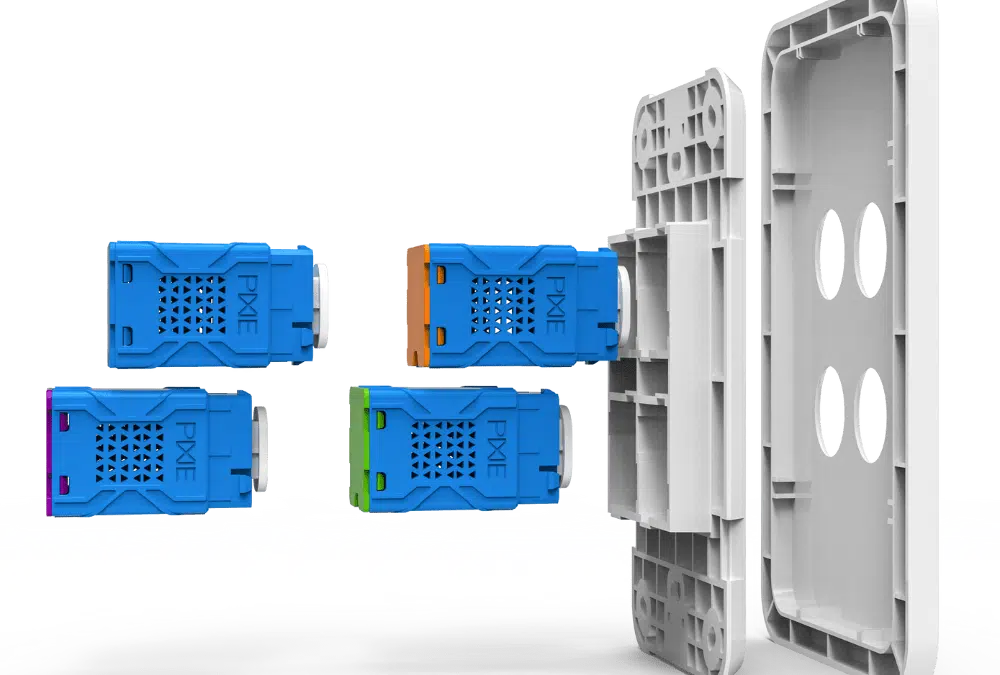
There is a second choice that buyers often miss. Some smart dimmers are modules that sit in the wall cavity behind an ordinary switch, while others are mechanisms that clip into the wall plate in place of the standard switch. Modules keep the existing switch but need space behind it, which older and shallower wall boxes do not always have. Mechanisms that fit standard Australian plates are swapped like for like, and the button on the wall is the dimmer itself.
Which type suits which home
- An existing home with no neutral at the switch: a two-wire Bluetooth mesh dimmer that fits the existing wall plate, since it avoids both new cabling and a hub.
- A single room or a rental-friendly setup: a wifi dimmer, or smart lamps, where the scale is small enough that the router is not stretched.
- A home already run from a hub by a confident owner: Zigbee dimmers that join the hub already in place.
- A new build: any of the three can work, so the decision turns on who will install and support the system over the years that follow.
Where the PIXIE smart dimmer fits
The PIXIE smart dimmer (SDD300BTAM) is a Bluetooth mesh mechanism made for the first of those situations, the existing Australian home that has LED downlights and two wires at the switch.
It does not need a neutral wire, so it replaces an existing switch or dimmer without new cabling. It clips into most Australian wall plates, with between one and six PIXIE devices on a single plate, which means the switch positions and the look of the wall stay as they are. It uses trailing edge dimming and works with dimmable LED downlights as well as dimmable halogen and incandescent lamps, carrying up to 250VA of LED load or 300 watts of resistive load, with a minimum load of 2 watts.
In parts of New South Wales and Queensland, the ripple control signals that electricity networks use to switch off-peak hot water can make LED downlights flicker, and solar installations can have the same effect. For those homes PIXIE makes the RippleShield dimmer (SDD400RSBTAM), which is paired with SAL RippleShield enabled downlights and dims without flicker down to 1 per cent of light output.
At the wall it behaves like a good dimmer should: a press turns the light on at the level it was last set to, a hold dims up or down, a double tap goes straight to full brightness, and a minimum level can be set so the lights never drop into the range where they would flicker. The indicator light on the button can be set to blue or orange.
In the free PIXIE PLUS app, dimmers can be grouped, scheduled and combined into scenes, and none of that needs a hub or an internet connection inside the home. Each device reaches the next over a typical range of 15 metres, so the mesh extends as more devices are installed. Adding a PIXIE gateway brings control from outside the home and voice control through Google Home, Amazon Alexa and Siri Shortcuts, and it keeps schedules running without interruption after a power outage.
PIXIE is sold through electrical wholesalers and installed by licensed electricians, and homeowners can find a trained installer through the PIXIE Certified Installer directory.
Where PIXIE is not the right choice
PIXIE is not a plug-in product, so it does not suit anyone who wants to install smart lighting without an electrician. For a single lamp or a single room, smart globes will usually cost less than installing a dimmer.
PIXIE, Home Assistant and Matter
PIXIE is built for electricians and everyday homeowners who want a smart home that is supported, repeatable and able to be serviced by any electrician who knows the product, and its position on the wider smart home world follows from that: native simplicity first, with interoperability where it counts.
Home Assistant. PIXIE does not publish its own Home Assistant integration, but Home Assistant users are not shut out. A member of the Home Assistant community has built one and shared it openly. It is called Pixie Plus Local, and it talks to the PIXIE Gateway directly over the local network, so that lights, dimmers, switches, plugs, RGB strips and blinds appear in Home Assistant as native devices. It needs a PIXIE Gateway, and it is an independent community project that is not developed or supported by PIXIE or SAL National. The full detail, including how to install it, is in How does PIXIE work with Home Assistant.
Matter. PIXIE has a clear pathway to Matter through a Matter bridge, which will expose an installed PIXIE system to Matter-aware ecosystems with no rewiring and no hardware replacement, so a system installed today is not made obsolete when that pathway lands. The bridge will follow when Matter has matured and Australian buyers are asking for it. In the meantime, flexibility across ecosystems is already available through Google Home, Amazon Alexa, Samsung SmartThings, Siri Shortcuts and IFTTT. The reasoning is set out in How does PIXIE work with Matter.
Frequently asked questions
Do smart dimmers need a neutral wire in Australia?
Some do and some do not. Many Australian homes have no neutral at the light switch, so a dimmer that needs one will require new cabling. The PIXIE smart dimmer is a two-wire design and does not need a neutral.
Why do LED downlights flicker on a dimmer?
The usual causes are a downlight that is not dimmable, a dimming method that does not suit LED, or a circuit whose total load sits below the minimum the dimmer needs. Choosing a trailing edge dimmer with a low minimum load, and setting a minimum brightness level, resolves most cases. In areas of New South Wales and Queensland where off-peak ripple signals are the cause, a PIXIE RippleShield dimmer paired with RippleShield enabled downlights deals with it directly.
Is a hub needed for smart dimmers?
It depends on the type. Zigbee dimmers need a hub, wifi dimmers use the home router, and Bluetooth mesh dimmers such as PIXIE need nothing extra for control inside the home. A gateway is added only for remote access and voice control.
Do smart dimmers work when the internet is down?
Bluetooth mesh dimmers keep working from the wall and from the app inside the home, because neither depends on the internet. With wifi dimmers the answer varies by product, so it is worth checking before buying.
Can a smart dimmer be installed without an electrician?
No. A dimmer wired into the mains is fixed electrical work and must be installed by a licensed electrician anywhere in Australia.
Will a smart dimmer fit an existing wall plate?
Mechanism-style dimmers made for Australian plates usually will. PIXIE mechanisms fit most Australian wall plates, with up to six devices on one plate.
Can smart dimmers be controlled by voice?
Yes. With a PIXIE gateway installed, PIXIE dimmers work with Google Home, Amazon Alexa and Siri Shortcuts.
Does PIXIE work with Home Assistant or Matter?
Home Assistant users can connect PIXIE through Pixie Plus Local, a community-built integration that talks to the PIXIE Gateway over the local network. It is an unofficial project and is not supported by PIXIE, which does not publish an integration of its own. On Matter, PIXIE has a clear pathway through a Matter bridge that will work with the system already installed, with no rewiring or hardware replacement. PIXIE already works with Google Home, Amazon Alexa, Samsung SmartThings, Siri Shortcuts and IFTTT.
Choosing the right smart dimmer
The right smart dimmer is decided by the house more than by the brochure. For an existing Australian home with LED downlights and two wires at the switch, a two-wire Bluetooth mesh dimmer installed by an electrician is the option that asks least of the building and of the household.